
Microsoft is closing the emergency exit on compute and database reservations. The announcement says less than what actually happens.
Microsoft is changing the exchange policy for Azure reservations: from 1 February 2027, exchanges are no longer available for any service covered by savings plans, compute and databases alike.
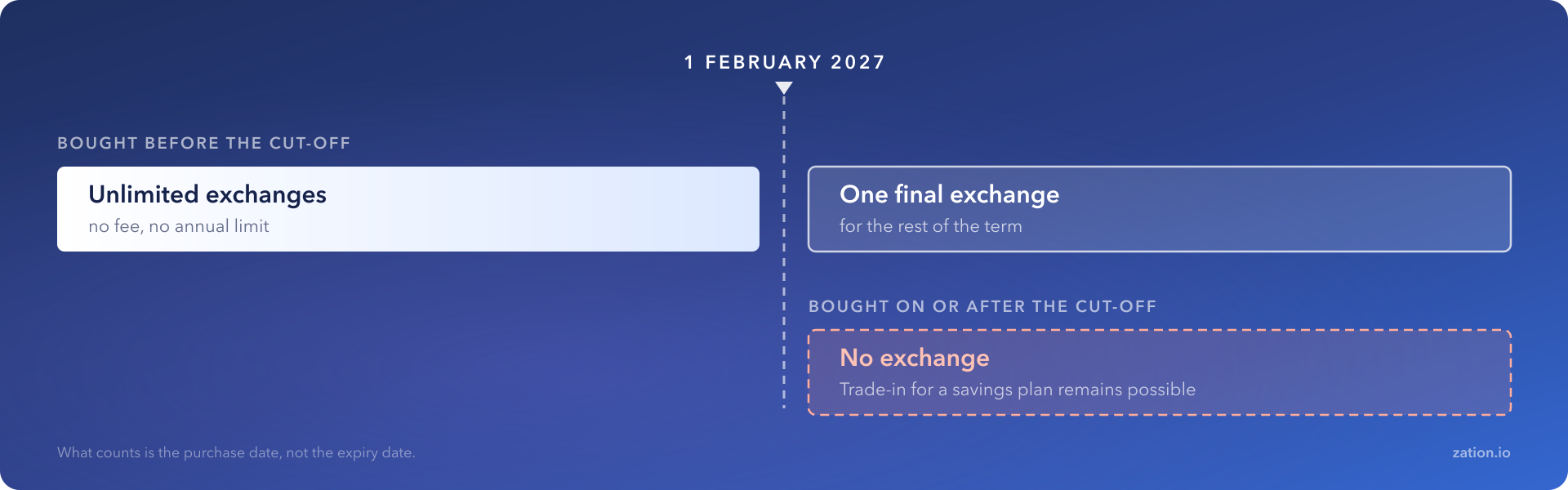
Reservations bought before that date keep the right to one final exchange. Reservations bought after it have none at all. In practice: six months to correct a portfolio that would otherwise stay as it is until the term ends.
1. What changes
The scope fits in one sentence: whatever a savings plan covers loses its exchange. That is effectively the entire compute and database portfolio. Virtual Machines and App Service belong to it just as much as SQL Database, PostgreSQL, MySQL or Cosmos DB.
What counts is the purchase date, not the expiry date:
- Bought before 1 February 2027. Unlimited exchanges up to the cut-off, then one final exchange for the rest of the term.
- Bought on or after 1 February 2027. No exchange at all.
- Exchanging after the cut-off. The resulting reservation is itself no longer exchangeable. Microsoft processes every exchange as a cancellation, a refund and a new purchase, and the new purchase falls under the new terms.
- Partial exchanges count per quantity. Exchange 2 of 10 instances and the remaining 8 each keep one final exchange.
What savings plans do not cover stays exempt. Azure VMware Solution is the clearest example. Instance size flexibility for virtual machines is unaffected. And any compute or database product that becomes savings-plan-eligible later falls under the same rule from that point on.
2. Two properties that limit the final exchange
Two things about exchanges are regularly misunderstood. Both determine what that final exchange is actually worth.
It does not reduce the commitment. The new reservation must at least match the remaining commitment of the old one. An exchange redirects the same money to a different workload. It was never a way out.
It resets the term. Change size, series, region or payment frequency and a new term starts from the moment of the exchange. The only exception is switching between non-premium and premium storage in the same region: free, with no new term. So anyone using their final exchange in 2028 commits again for one or three years.
3. The ways out
| Exit route | After 1 February 2027 | Constraint |
|---|---|---|
| Exchange, bought after the cut-off | Not available | Applies to every service savings plans cover |
| Exchange, bought before the cut-off | Once | Successor reservation no longer exchangeable; also resets the term |
| Trade-in for a savings plan | Unchanged, no deadline | New commitment at least as high as the remaining one; max. 100 reservations per transaction |
| Cancellation and refund | Unchanged | USD 50,000 per rolling 12 months, per billing profile or enrollment; per customer in CSP |
| Instance size flexibility (VMs) | Unaffected | Only within the same VM series and region |
The obvious way out is a trade-in for a savings plan. It hits the same floor. A three-year reservation at USD 100 per month, traded in after the eighteenth payment, requires a new commitment of at least USD 1,800. The form of a commitment can change, the amount cannot.
The destination is also more rigid than the starting point: a savings plan can be neither exchanged nor cancelled. A reservation at least keeps a capped right of cancellation. For genuinely dynamic workloads the trade-in is right. As an escape from too much commitment it is the wrong answer.
4. The USD 50,000 limit becomes a real barrier
The cancellation rule does not change: a maximum of USD 50,000 in cancelled commitment per rolling 12 months, per billing profile or enrollment, per customer in CSP. What changes is its weight. Today a refund from an exchange does not count against it. Remove the exchange and every correction runs through cancellation, and that is capped.
Microsoft works the example itself: a three-year reservation at USD 3,000 per month adds up to a commitment of USD 108,000. Because of the 50,000 threshold it cannot be cancelled until USD 58,000 of it has been consumed. Only then does the remaining commitment fall below the threshold.
This is a prohibition, not a fee. Above the threshold Microsoft simply does not process a refund. There is no surcharge that buys an earlier exit. The 12 per cent early termination fee, which Microsoft does not currently charge and only reserves for the future, changes nothing here: it would affect the price of a permitted cancellation, not whether one is permitted. The limit therefore bites hardest exactly when you most want out: early in the term.
5. Four steps for the next six months
1. Take inventory. Utilisation over the last 90 days, remaining term, stability of the workload. The bulk exchange in the portal offers “Optimize for utilization (7-day)” as a starting point. At the same time, check who holds owner or reservation administrator rights on the reservation orders. Without that role nothing can be triggered.
2. Use the window while it is open. Until 31 January 2027 exchanges are possible without fees and without an annual limit. Wrong region, wrong series, oversized against a 2024 forecast. Correct it while it is free.
3. Reassess the three-year term. The extra discount on 36 months buys a markedly less flexible instrument than it did last year. Where a workload cannot be forecast reliably over three years, a one-year reservation or a savings plan may come out ahead.
4. Check renewal dates. Reservations expiring in 2027 will be repurchased under the new rules. The successor reservation is no longer exchangeable. Making that decision in January beats discovering it in March.
Questions to ask before the next reservation purchase
- What is the measured utilisation of comparable existing reservations, not the forecast one?
- Is a migration, a replatforming or a region change planned within the commitment term?
- If this commitment turns out to be wrong in month nine: what does the exit look like, and what does it cost?
- Are we buying before or after 1 February 2027, and have we decided deliberately which side of that line we want to be on?
Bottom line
Reservations remain the instrument with the deepest discount Azure offers. What changes is the cost of a bad forecast. Until now a mis-sized reservation could be redirected to another workload: one exchange, done. From February 2027 it stays where it is until the term ends.
Anyone with a solid consumption baseline loses little. Anyone who has used the right to exchange as a substitute for planning will pay for it. The coming six months are the last opportunity to clean up the portfolio at no cost. That deserves a scheduled review, not a note in the January calendar.