As we enter 2026, the era of "negotiated complexity" in Microsoft licensing has officially ended. For over two decades, the Enterprise Agreement (EA) was the bedrock of corporate IT procurement. But as of today, that foundation has shifted.
The transition that Microsoft accelerated in late 2024 has reached its peak. For organizations still clinging to legacy structures, the renewal cycle in 2026 is no longer a routine paperwork exercise: it is a significant financial risk. At Zation, we are seeing a common trend: companies are being pushed into the Microsoft Customer Agreement (MCA) framework, often without realizing that the rules of the game have fundamentally changed.
To understand your current bill, you must look at the roadmap of the last 18 months.
If you are renewing a contract today, you are likely facing a "Level A" price list, regardless of whether you have 500 or 50,000 users. The 10-15% discounts that large enterprises (Level C and D) once took for granted have largely evaporated from the standard price list.
To choose the right path, you must look beyond just the price per seat. Here is how the three main models stack up in the current market:
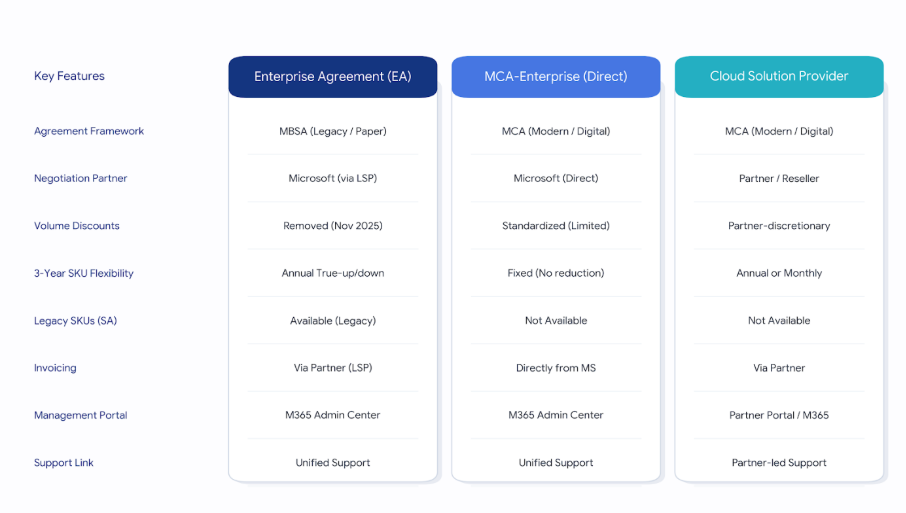
The Death of FromSA and LicSA
In the legacy EA world, many customers used FromSA (From Software Assurance) SKUs. These were highly discounted licenses designed to reward customers for their historical on-premises investments. In MCA-E and CSP, these SKUs simply do not exist. When you migrate, you move to full-price subscriptions. For a company that has spent 15 years building equity in on-premises licenses, this transition can feel like losing an asset and being forced to rent it back at a premium. The average impact we are seeing is in average 15% when comparing FromSA pricing vs full price subscriptions
The Rigid 3-Year SKU Trap
Microsoft introduced 3-year SKUs in the MCA-E to provide price stability. However, there is a dangerous catch: flexibility has been removed. In a classic EA, you could typically reduce your seat count at your annual anniversary (the "True-down"). In the MCA-E, if you commit to 10,000 M365 E5 seats for three years, you are billed for 10,000 seats for the duration of that term. There is no annual reduction mechanism. If your company downsizes or divests a department, you are left with "shelfware" that you are contractually obligated to pay for.
The Unified Support "Multiplier"
Perhaps the most overlooked cost is Unified Support. Because Unified Support fees are calculated as a percentage of your total Microsoft spend, every dollar added to your license bill by the removal of volume discounts has a "multiplier effect."
In 2026, the "Who" is as important as the "What."
Direct with Microsoft (MCA-E/EA)
You are dealing with a sales machine driven by standardized metrics. There is very little room for "bespoke" deals unless you are a global top-tier account.
Via Partner (CSP)
The CSP model allows for a more traditional business relationship. Partners have their own margins and can often "give back" some of that margin in the form of lower prices or bundled services to win your business. In 2026, we are seeing many enterprises move "commoditized" workloads (like M365) to CSP while keeping complex Azure workloads in MCA-E.
The switch to MCA-E changes the flow of money. In a CSP, you pay your Partner, in an EA you paid Microsoft but ordered via a partner. In a MCA-E, you pay Microsoft directly. While this sounds simple, it often requires a total overhaul of the procurement process. Microsoft’s direct invoicing system is automated and rigid. If your internal PO process doesn't align perfectly with their digital billing cycles, services can be suspended automatically—a risk that was much lower when a Partner acted as a "buffer."
How Zation Protects Your Budget
In this new reality, the "standard" price is rarely the best price. At Zation, we specialize in identifying the hidden costs of the MCA transition.
Don't navigate the 2026 licensing world alone. If you are facing an upcoming renewal or a forced migration to MCA-E, let us ensure you aren't paying the "default" price increase (typically 30-45% over 3 years).