Microsoft officially released SQL Server 2025 on November 18, 2025. While every new version brings technical updates, the 2025 release is a landmark for procurement and IT strategy. It fundamentally changes the value proposition of the Standard Edition, offering a unique opportunity for organizations to re-evaluate their high-cost Enterprise spend.
Here is a breakdown of the critical licensing changes and the financial opportunities they create.
The most significant licensing win in this release is the democratization of the Power BI Report Server (PBIRS).
Microsoft has officially retired the Web edition with the 2025 release.
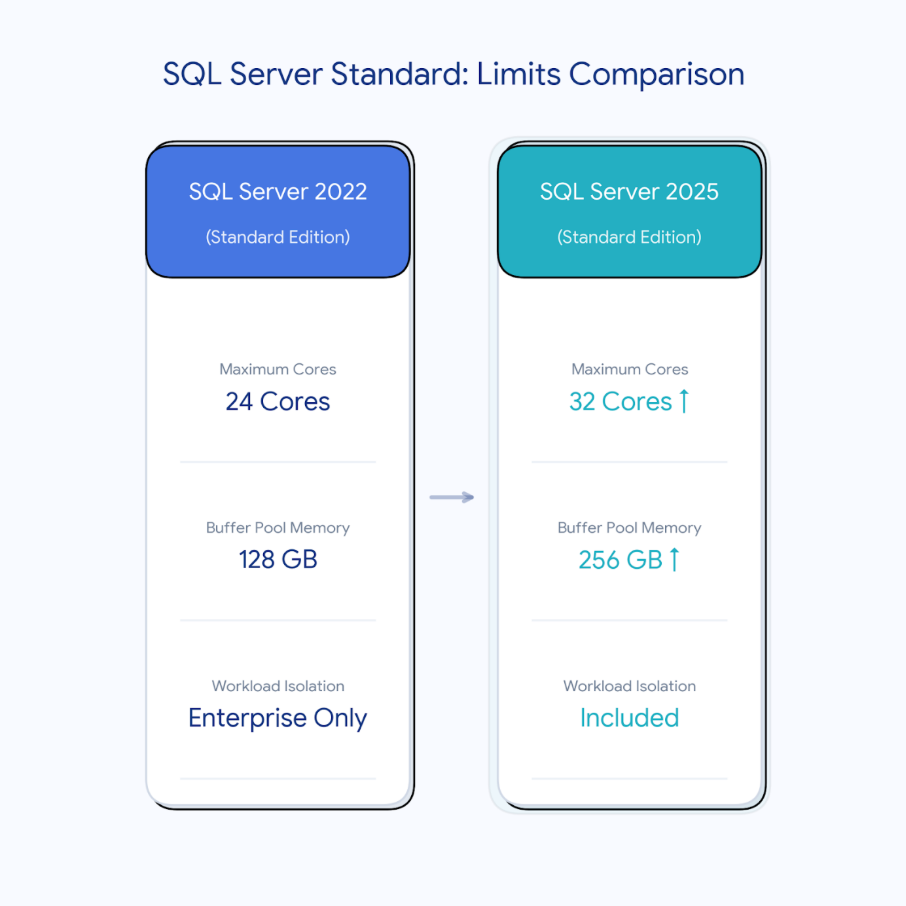
SQL Server 2025 significantly expands the hardware limits for the Standard edition. For many organizations, this eliminates the "forced upgrade" to Enterprise just to access more compute power.
The following infographic highlights the key capacity and feature improvements in SQL Server 2025 Standard Edition compared to its predecessor.
The gap between Standard and Enterprise pricing remains steep. Enterprise Edition typically costs approximately four times more per core than Standard.
Avoiding the "Capacity Trap"
Previously, a server with 32 cores or a database requiring 160 GB of RAM fell into a "Capacity Trap." Even if you didn't need advanced features, you were forced into Enterprise pricing to utilize your hardware.
The Math of the Upgrade:
While the capacity limits are generous, Microsoft still reserves "Mission Critical" high-availability features for the Enterprise Edition. Before you decide to stick with Standard to save costs, you must verify your HA requirements.
Key HA Differences:
Official Comparison: For a complete, line-by-line feature matrix, refer to the official documentation on Microsoft Learn: Editions and Supported Features of SQL Server 2025
While planning your adoption of SQL Server 2025, it is crucial to address your legacy footprint. Support for SQL Server 2016 officially ends on July 14, 2026.
After this date, Microsoft will no longer provide security updates, bug fixes, or technical support, leaving your infrastructure vulnerable to compliance risks and security threats. We strongly recommend using the rollout of SQL Server 2025 as a catalyst to migrate remaining 2016 workloads. Combining this migration with the new cost-saving potential of the 2025 Standard Edition can turn a necessary compliance project into a significant cost-optimization win.