Along-standing practice in Microsoft license management is coming to an end: the free grace period after contracts expires. What has been a reality for customers in the Enterprise Agreement (EA) for some time is now also becoming the rule in the Cloud Solution Provider (CSP) program. Microsoft is replacing the previous courtesy phase with a paid model, which means an increased cost risk for companies and the absolute necessity for proactive license management.
Based on official Microsoft documentation, the logic already in place in the EA will now be applied to the CSP program and will take effect for all renewals starting May 4, 2026.The previous structure in CSP, where the main risk was data loss, will be replaced by a model focused on cost risk.
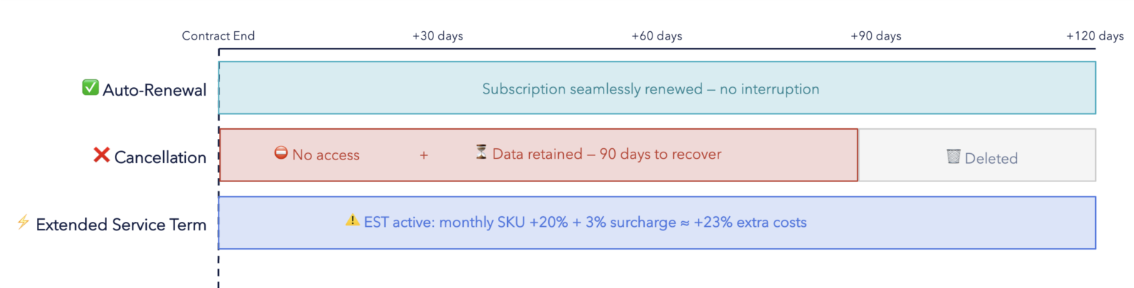
At the end of a subscription term in CSP, there will be three defined options in the future:
1. Renew (Auto-Renewal): The subscription continues as planned.
2. Cancel: The service ends immediately at the end of the term. Users lose access to the services instantly!
a. What happens to the data? The data is not deleted immediately. It enters a 90-day data retention phase. Within this period, the data can be recovered by purchasing new, equivalent licenses. After 90 days, the data is permanently deleted.
3. Switch to the Extended Service Term (EST): This is the new default setting if no active decision is made. It leads to:
a. Billing based on the more expensive monthly SKU. This means a 20% surcharge compared to annual subscriptions.
b. An additional surcharge of 3%.
The EST can lead to a potential cost increase of +23%!
Example: M365 E3 annual ≈ $36 → ≈ $44.28 under EST.
For a company with 500 users, this means an annual cost increase of $49,680!
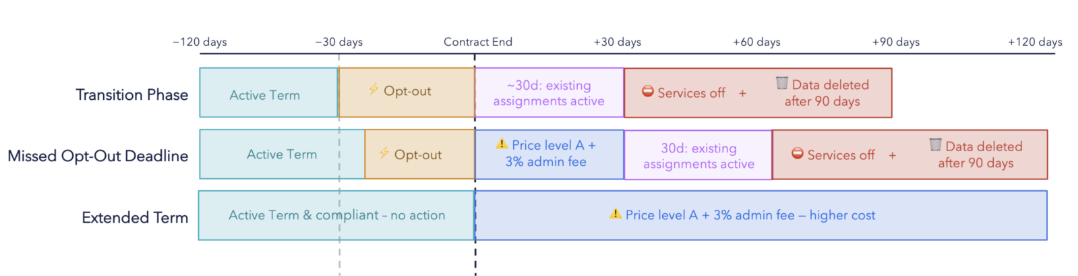
For customers with an Enterprise Agreement, the abolition of the grace period is not new, but established practice. The former 30-day grace period was replaced by the so-called "Extended Term" some time ago. If an EA expires today without a renewal or cancellation, it has immediate financial consequences:
Automatic monthly billing: The Online Services are immediately billed at significantly higher list prices (Price Level A).
Additional administrative fee: A fee of 3% is added to these costs.
Another critical point often overlooked in this context is the deadline for changing a provider. The opt-out from the existing reseller (LSP) must occur at least 30 days before the contract ends. If this deadline is missed, the contract may continue under the Extended Term.
Even if the commercial contract is terminated, Microsoft does not switch off the services immediately. Instead, a technical transition phase begins to ensure service continuity and enable a seamless switch. From this moment on, however, the company is in a non-compliant state.
This transition phase (approx. 30 days) has the following characteristics:
Existing assignments remain active: Users with already assigned licenses can initially continue to work to avoid an abrupt service interruption.
No new assignments possible: The crucial point is that no more licenses can be assigned to new or previously unlicensed employees from this expired contract pool. The pool is locked for new assignments.
If no proactive action is taken by purchasing new licenses, Microsoft's standard process takes effect: After about 30 days, the services will be deactivated, meaning users will lose access. After another 90 days, the data will be permanently deleted, and the licenses will also be removed from the tenant.
The abolition of the grace period makes proactive action mandatory. Passivity leads directly into a cost trap. With these four measures, you remain in control:
Conclusion: Microsoft is shifting the responsibility entirely to the partner and the customer. The new reality requires transparency, clear processes, and strategic planning to avoid unnecessary costs.