Microsoft 365 E7 is not just a new bundle. It introduces a new operating model for enterprise IT.
The $99 price per user looks attractive, but it only represents the entry point. Real costs are driven by a combination of licensing and AI consumption, making total cost of ownership significantly more complex and less predictable.
E7 is designed to accelerate enterprise-wide AI adoption. At the same time, it shifts Microsoft’s commercial focus toward bundled full-stack deployment, reducing flexibility and increasing the risk of over-licensing.
We expect strong E7 promotions to drive adoption in the short term. However, this will likely come at the cost of reduced incentives for E3 and E5, leading to indirect cost increases across the broader portfolio.
For organizations, success with E7 depends on three factors. Clear demand definition, controlled rollout and strong negotiation. Without this, E7 quickly becomes a structural cost driver rather than a value enabler.
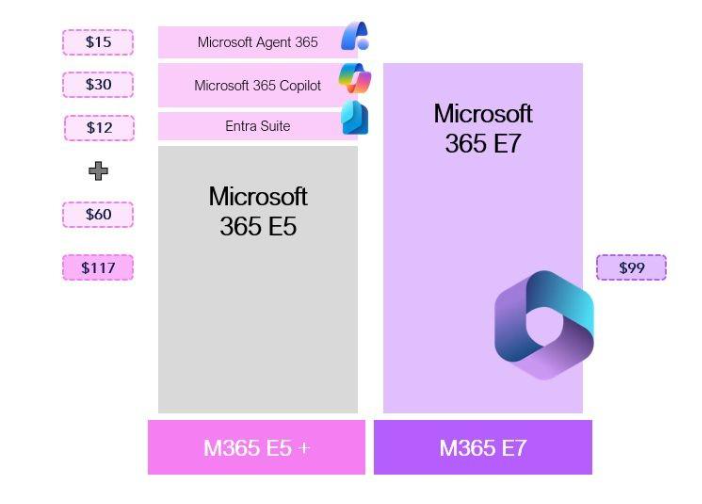
The visual illustrates the core idea behind Microsoft 365 E7 more clearly than any documentation. On the left side, the traditional approach is shown. Organizations build their environment step by step, starting with Microsoft 365 E5 as the foundation and adding components such as Copilot, the Entra Suite and Agent 365 on top. This results in a combined price of approximately $117 per user per month.
On the right side, Microsoft collapses this layered model into a single bundled license priced at $99 per user per month. The positioning is clear. Instead of assembling capabilities individually, customers are encouraged to adopt the full stack upfront at a perceived discount.
However, the visual also reveals the key assumption behind the bundle. The value only materializes if the entire stack is actually required and used. If parts of the stack remain unused, the bundled model quickly shifts from a savings mechanism to a cost expansion model.
The transition from the left side of the visual to the right side is not just a pricing adjustment. It reflects a change in operating logic. Previously, organizations could selectively deploy capabilities based on actual demand. With E7, the decision shifts toward standardization. Instead of asking which users need Copilot or advanced identity governance, the bundle assumes that most users will need everything.
This is where the first structural risk appears. In most environments, demand is heterogeneous. Not every user requires AI assistance, advanced identity governance or agent interaction. By bundling all components together, Microsoft effectively averages demand across the organization. This creates a mismatch between actual usage and licensed capability.
While the image suggests a clear savings of roughly 15 percent, the financial reality is more nuanced. The bundle price of $99 represents only the fixed component of the cost. It grants access to the capabilities but does not cover the execution of AI workloads.
Agent 365 is a governance layer. It ensures visibility, control and compliance for AI agents, but it does not build or run them. The actual execution requires additional services such as Copilot Studio or Azure-based AI resources, which are billed separately based on consumption.
This introduces a hybrid cost structure where the license defines a fixed cost baseline, while AI usage introduces a variable cost layer. The visual therefore represents only the entry point into the cost model, not the full economic reality.
At the same time, it is very likely that Microsoft will introduce aggressive E7 promotions to accelerate adoption. These promotions will make entry into the bundle financially attractive in the short term, especially as Microsoft is under pressure to drive AI adoption at scale.
However, this comes with a structural downside. As the focus shifts toward E7, promotional intensity for E3 and E5 is expected to decrease. This creates indirect cost pressure across the existing license base, which in many cases can outweigh the visible savings of the E7 bundle itself.
A particularly important element in the bundle is Agent 365. It acts as a governance layer for AI agents and introduces a new licensing dimension.
If AI agents are used across the organization, governance requirements typically extend to all interacting users. This means that even targeted AI use cases can lead to broad licensing requirements. The result is a cost floor that applies before any measurable business value is generated.
The structure reflects a clear strategic direction. Microsoft needs to scale AI adoption while monetizing significant infrastructure investments. By bundling AI, identity and security into a single license, the company reduces adoption friction and encourages full-stack standardization.
This follows a known pattern. Capabilities are introduced at scale, but proper usage requires full licensing coverage. Over time, this leads to expansion across the user base. E7 extends this model into the AI domain.
Organizations are moving from modular decision-making to strategic commitment. Instead of selecting individual components, they are deciding whether to adopt a full AI-enabled workplace model.
This increases complexity in three areas. Cost becomes more dynamic, governance requirements expand and value realization depends heavily on utilization. Without a clear adoption strategy, there is a high risk of over-investment without proportional return.
The introduction of E7 changes negotiation dynamics significantly.
The starting point must always be a clear understanding of demand. Organizations need to know which users actually require E7 capabilities and which do not. Without this clarity, negotiations default to Microsoft’s full-stack assumption.
Competition is becoming increasingly relevant. Alternatives such as Gemini, Claude and other AI platforms provide strategic leverage. Even if not fully adopted, they challenge Microsoft’s positioning and strengthen negotiation power.
If E7 is strategically relevant, timing is critical. Microsoft is currently under pressure to drive adoption and meet AI-related KPIs. This creates an early-adopter window where incentives, discounts and flexible terms are more achievable.
Strong negotiation is therefore based on three elements. Clear demand, credible alternatives and the right timing.
Microsoft 365 E7 requires a fundamentally different approach to licensing and cost management. Static procurement is no longer sufficient.
At Zation, we help organizations create full transparency on demand and utilization, ensuring that licensing aligns with actual needs rather than bundle assumptions. We define clear AI and licensing strategies, model financial scenarios across multiple years and provide hands-on support in negotiations with Microsoft.
This ensures that organizations maintain control over cost, adoption and value realization.
Our approach follows a continuous FinOps cycle of Inform, Optimize and Operate, enabling long-term optimization rather than one-time cost reduction.
Microsoft 365 E7 is not just a new license. It is a new operating model. The bundled structure simplifies procurement but introduces complexity in cost control. The license defines the cost floor, while AI consumption defines the cost ceiling.
Organizations that succeed with E7 will not be those that adopt it fastest, but those that manage demand, utilization and negotiation with precision.